

In popular science or TV documentaries, the past is often presented as a series of clear-cut facts. However, within the scholarly community — among researchers and scientists — it is common knowledge that “we do not know for certain” is the most frequent starting point.
Much of what we consider established knowledge in the Classics is, in fact, a convention: a necessary pillar to hold up a complex structural argument. When new evidence emerges — a single coin found in a new context — these pillars can shake, and decades of scholarly consensus may need to be re-evaluated. This uncertainty is not a flaw; it is the essence of historical research.
The Evolution of a Compromise
From Free Text to Normalization
In the mid-2010s, when projects like Corpus Nummorum established their digital presence, relational databases were the standard (and they still are). At that time, capturing the nuance of scholarly doubt was handled through the most flexible tool available: the free-text field — hard to query, but close to the “truth”.
To denote uncertainty, we used the question mark. An coin obverse description like ”Bust of Poseidon?, right” was a deliberate attempt to maintain scientific integrity within a rigid system. The question mark served as a warning to the reader: ”This is an interpretation, not an absolute identification.” [1]
The challenge shifted as we entered the era of the Semantic Web and NLP (Natural Language Processing). To make data machine-readable and interoperable, text must be normalized. In the process, the question mark became a problem: ”Poseidon?” is not an entity. To create valid data, one often had to choose: either ignore the record or drop the uncertainty to fit the schema.
This was not a sin, but a technical necessity of the time. While standards like CIDOC CRM already provided ways to model uncertainty, they often lead to deep, complex event-chains that cripple the performance of databases in an academic environment with limited hardware resources, make it unusable.
Lessons Learned
Reifying the Act of Interpretation
In our new long-term project, Imagines Nummorum (2025–2050), we are building a numismatic thesaurus that focuses specifically on the iconography of ancient Greek coinage. We have reached a point where we can no longer afford to ignore uncertainty in structured data: If we feed AI systems and Knowledge Graphs with forced certainties, we are creating a digital memory that hallucinates facts where a scientist would express doubt. Doubt is our sharpest sword against presumption.
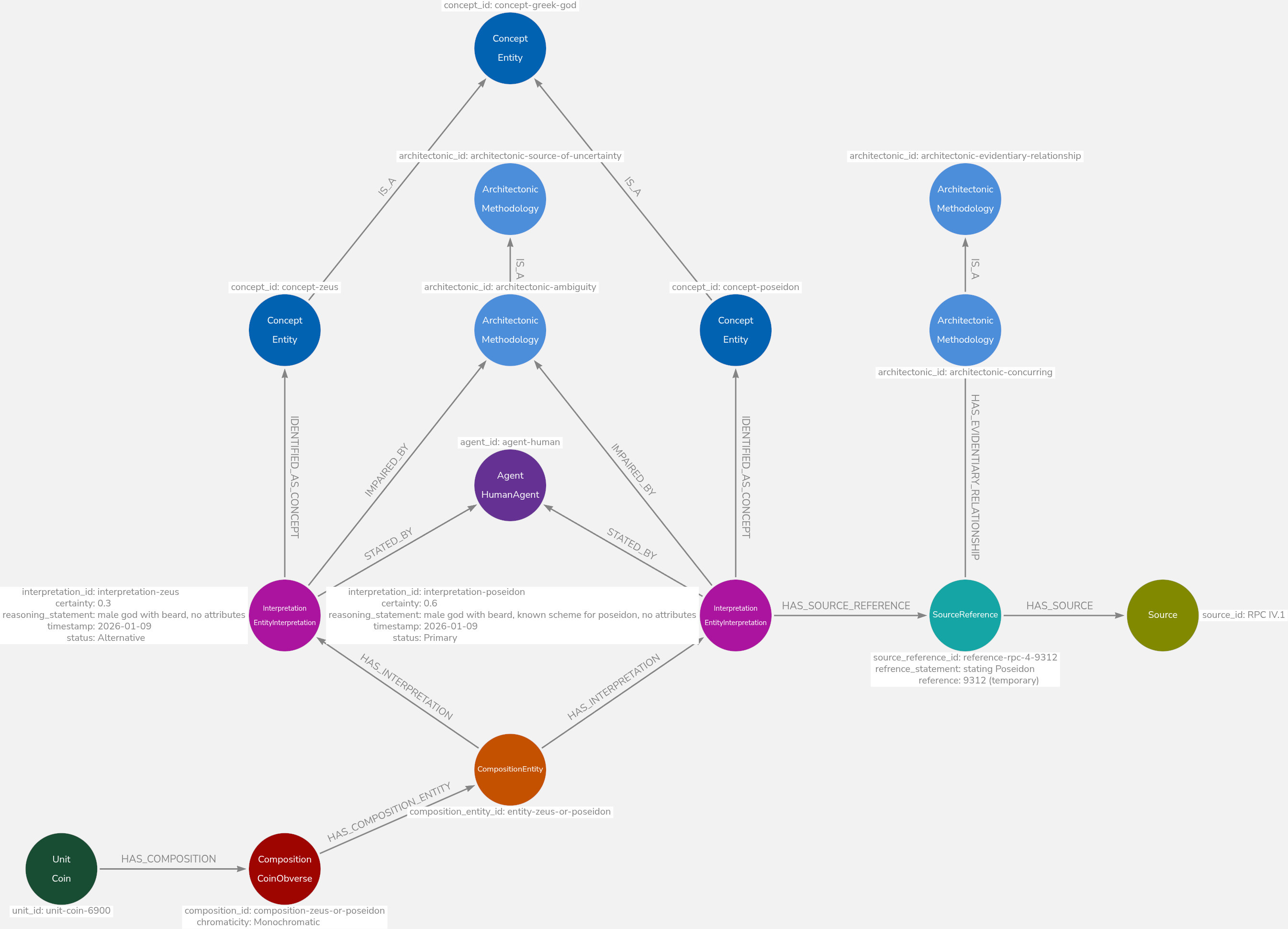
Our approach in the IDEA Graph Framework utilizes the maturity of modern Property Graphs to merge the integrity of relational systems (by using the Graph as a read-only projection of a relational SSoT) with the query performance of graphs. One central pillar of this model is the reification of the act of interpretation.
Instead of treating certainty as a mere property (a quantitative score), we represent the interpretation itself as a node. This allows us to create:
Connect the visual evidence to multiple, even conflicting, conceptual identities.
Link the uncertainty directly to the research literature or the specific reason for the ambiguity (e.g., visual wear or typological deviation).
Maintain a flat, high-performant structure that grows in width, not in depth, remaining scalable even on large datasets (when using materialized path properties for the ontology nodes)
A Call for Methodological Rigor
By structuring doubt, we transform the old free-text question mark into a measurable dimension of data. The resulting graph will not be a collection of truth-claims; it is a structural reflection of scholarly discourse.
We have published the blueprint of the IDEA Graph Framework on GitHub under the Apache 2.0 license: github.com/imagines-nummorum/idea-graph-framework
The architecture is modular, its core is domain-agnostic, designed to describe any kind of static visual composition. We invite the community — not to follow a new trend, but to audit the logic of this foundation. Break it, so we can build a stable foundation for decades of research!
In an era of agentic AI, scientific integrity depends on our ability to communicate not just what we know, but the exact nature of what we don’t.
---
[1] A question mark primarily denotes uncertainty without detailing alternatives or underlying reasons. In the example cited, the alternative “Zeus” was moved to the comment field for a specific reason: including “Poseidon or Zeus” in the free-text description would cause this record to appear in searches for both “Poseidon” AND “Zeus,” as keyword-based retrieval lacks the capacity for semantic differentiation.